
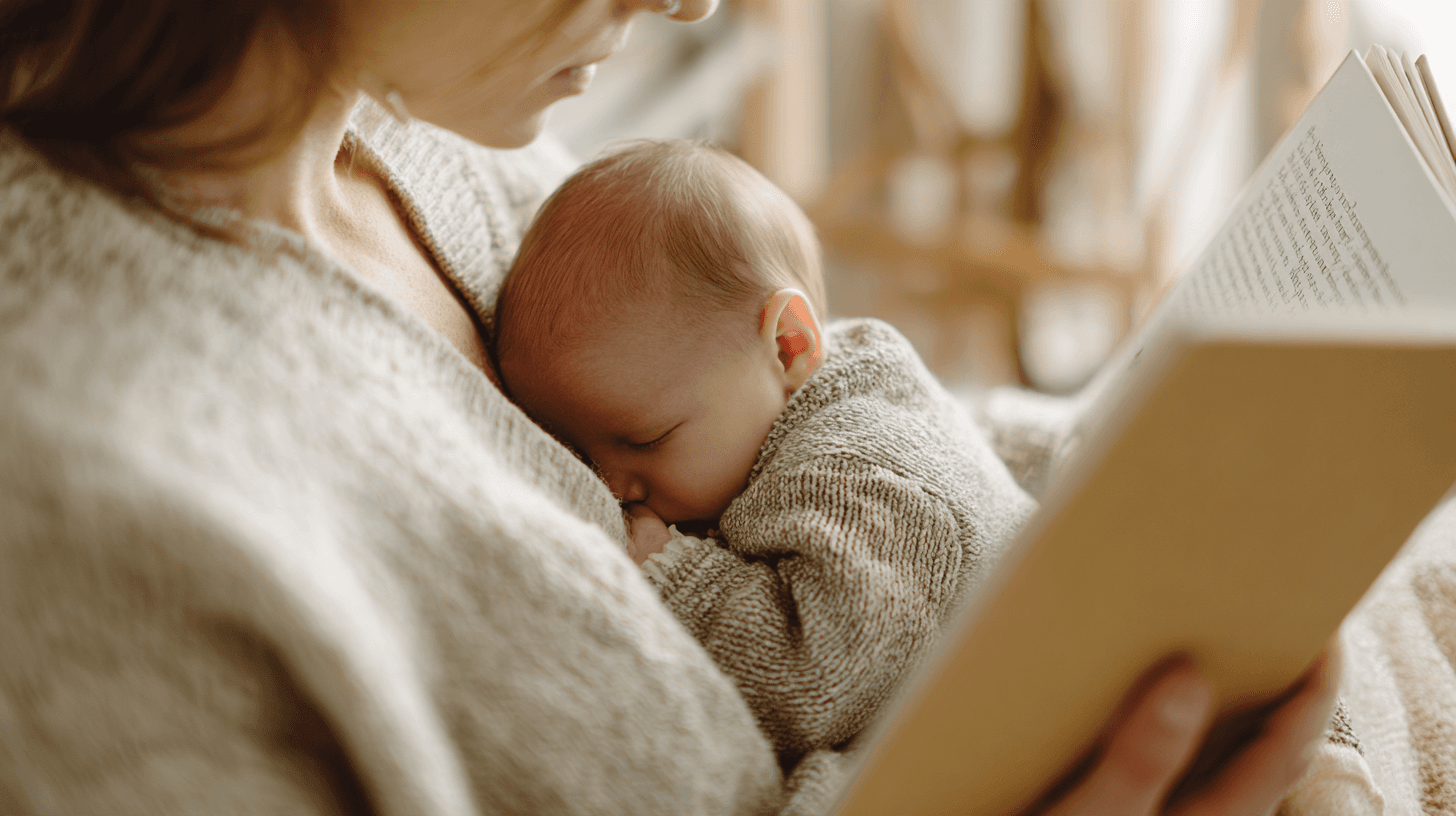
Reading From Birth: What a Baby Receives Before Understanding Words
During the first weeks, the scene can seem almost unreasonable. The baby sleeps, looks away or waves their arms while an adult opens a picture book whose plot and words they clearly cannot understand. Nothing yet resembles the attentive reading imagined with an older child. There is no question about a character, no favourite page and sometimes no gaze directed towards the book at all.
Yet something is already happening. A familiar voice slows down. The adult’s body provides support. Sentences return with their own music, and the illustrations define a small shared space. A newborn is not “reading” in the school sense. They are entering a situation made of language, rhythm and closeness. The value of the moment does not depend on what they can later demonstrate. It begins with the experience they receive.
Before Meaning, the Music of a Voice
Language reaches a baby long before it becomes a sequence of understood meanings. They encounter its variations: a voice rises, slows, softens or pauses. A book gives the adult language that differs from everyday practical talk. Sentences are often more structured, repetitions more distinct and words less ordinary than those used to describe a feed or a nappy change.
This richness does not turn reading into early instruction. A baby is not expected to memorise vocabulary. They simply hear language being addressed to them by someone who is present. The adult may read the text, describe a picture or repeat a single phrase. At this age, a book is less a programme to complete than a support for varying the voice and sustaining gentle attention.
In 2024, the American Academy of Pediatrics reaffirmed that shared reading should be encouraged from birth and continue at least through kindergarten. Its recommendation is not based only on later reading skills. It connects books with language-rich interactions, social-emotional development and early relational health: the quality of the stable, attentive and nurturing relationships surrounding a young child.
What a Newborn Can Actually Receive
A newborn cannot examine an illustration for long. Their attention is brief and depends on hunger, tiredness, discomfort and availability. They can nevertheless receive several dimensions of the moment without “looking properly” at the book.
First, they receive continuity. A voice returns as the pages turn. They may also receive physical closeness when it is welcome: the warmth of a chest, a supporting arm and familiar breathing. Finally, they encounter a form of shared attention. Even when their gaze drifts elsewhere, the adult watches their responses, alters the pace and can stop when the baby signals that they have had enough.
This adjustment is essential. Reading to an infant does not mean persevering to the final page at all costs. The baby participates through very small signs: sudden stillness, a movement, a sound or a returning gaze. The adult learns to read those signals while reading the book.
How a Reading Routine Develops During the First Year
A study of reading practices during the first year followed two cohorts of families who received shared-reading guidance from the newborn period. At the two-week visit, fewer than half had begun reading with their baby. By twelve months, more than 97% had done so. About two-thirds already owned more than ten children’s books at two weeks; that proportion rose above 80% by the first birthday.
The study also compared books distributed from two weeks with distribution beginning at six months. This difference did not alter the reading trajectories. The result discourages overly simple commercial conclusions: placing a book in a home is not enough to create a practice. Guidance, parental confidence and the gradual development of a routine matter too.
These figures do not mean every family should reach the same rhythm. They suggest that the first year is a period in which habits can emerge even when they are absent in the earliest days. There is no lost time to recover. Families can begin with a few minutes whenever both baby and adult are available.
Possible Support for the Relationship, Without a Magical Promise
Another study followed 293 low-income mothers and their children between six and eighteen months. Shared reading at six months was associated one year later with greater reported and observed parental warmth, stronger observed sensitivity and lower parenting stress, after accounting for several baseline risks and intervention-group status.
The important word remains “associated”. Researchers observed a relationship over time, not proof that a picture book alone caused these changes. Families who read more may also benefit from other favourable conditions. Conversely, a book may provide a repeated structure that makes calm interaction easier. Those influences can reinforce each other.
This caution protects the genuine value of reading. An exhausted parent should not hear that missing several days will damage their bond with a baby. Books offer one possibility among many for talking, singing, looking and being together. They do not replace care, play or ordinary conversation.
How to Read During the Early Stages
From birth to around three months, one or two pages may be enough. The adult can choose language they enjoy saying, settle into a comfortable position and allow the baby to listen without demanding eye contact. Clear visual contrasts may be easier to perceive, but voice and closeness remain central.
Between three and six months, a baby follows faces, colours and movement more readily. The adult can hold the book at a comfortable distance, name one image and leave a pause. Once the baby begins to grasp objects, the book also becomes material: they want to touch, pull or mouth it. This exploration is not bad reading. It is part of discovery.
Between six and twelve months, the child may recognise pictures, anticipate a familiar phrase and participate through sounds. Sturdy pages and bindings make supported handling easier. A large A4 hardcover remains an object to hold with an adult: its format offers generous illustrations for sharing, but it is not designed for independent handling in the same way as a small board book.
The Most Expressive Language Is Often the Best One
Some families hesitate to read in a language different from the language of school or the country in which they live. There is no reason to abandon the language in which the adult feels most natural. A free, precise and affectionate voice offers a richer experience than a constrained reading in a less familiar language.
Bilingual families can alternate languages, keep certain stories associated with one grandparent or describe the same picture in different words. A baby does not require every adult to sound the same. They gradually learn that different sounds can name the world and carry the same attention.
What If the Baby Does Not Look at the Book?
Nothing needs to be corrected. An infant may listen while looking at the adult’s face, the light in the room or a point behind the book. Their attention is mobile and fragile. If they arch away, cry or turn their head for a sustained period, it is better to stop. Respecting that signal is part of the shared experience.
Duration is not a measure of quality. Thirty peaceful seconds may be more appropriate than a complete story imposed on a tired baby. The ritual can lengthen with age, familiarity and interest.
Which Book Should Families Choose First?
The best first book is not necessarily the one making the largest educational promise. Choose clear illustrations, language you enjoy saying and an object sturdy enough to revisit. A personalised story may give adults another way to speak about the child’s arrival, name and place in the family. For the baby, that meaning becomes accessible gradually; for the people around them, it exists from the first day.
It helps to distinguish a book shared with an adult from one handled independently. A large hardcover picture book suits supported reading on a lap. A small board or cloth book can remain within reach for the baby’s own exploration. The two uses complement each other.
Beginning Without Turning Reading Into an Obligation
Reading from birth should not add another task to days already transformed by a new baby. The moment may consist of one page after a feed, a few sentences while another adult prepares the room, or a story revisited several times during the week. It does not need to happen every day to be valuable.
The baby will not consciously remember their first picture book. They may nevertheless grow within a home where books have a place, where a voice pauses to address them and where stories become familiar. Before understanding words, perhaps this is what they receive: the sense that language is meant for them and that someone is willing, for a moment, to follow its rhythm beside them.
To welcome a child with a story carrying their name and family, explore Pétunia Chatterton personalised books.
Scientific sources
Literacy Promotion: An Essential Component of Primary Care Pediatric Practice — American Academy of Pediatrics, 2024
Shared Reading Practices and Early Literacy Promotion in the First Year of Life — Journal of Developmental & Behavioral Pediatrics, 2019
Beyond Language: Impacts of Shared Reading on Parenting Stress and Early Parent-Child Relational Health — Journal of Developmental & Behavioral Pediatrics, 2020